
What Independent Research Reveals About Migration Challenges - and How to Reduce Risk

SAP S/4HANA migration is no longer a strategic option – it is an operational imperative. As end-of-maintenance deadlines approach and cloud transformation programs accelerate, organizations worldwide are moving from planning to execution. Independent research confirms strong migration momentum, with a majority of enterprises either already live or actively transitioning to S/4HANA environments.
However, the same research reveals a consistent pattern: technical conversion is not the primary risk. Instead, data quality deficiencies, excessive custom code, undocumented process variations, and unclear system scope represent the most significant barriers to cost control and post-go-live stability.
Organizations that treat migration purely as an infrastructure upgrade frequently encounter oversized HANA environments, prolonged hypercare phases, reconciliation issues, and escalating cloud operating costs. By contrast, enterprises that combine structured migration frameworks such as RISE with SAP with systematic data intelligence, transparent system analysis, and governance-driven scoping achieve measurably lower risk, reduced migration volume, and faster stabilization.
The evidence is clear: successful SAP S/4HANA transformation requires more than system conversion. It requires informed scope decisions, data validation discipline, and architectural simplification before cutover, not after.
SAP S/4HANA Migration Momentum Is Real - But Complexity Remains
The shift from legacy SAP ECC landscapes to SAP S/4HANA is accelerating as organizations prepare for end-of-maintenance deadlines and increased cloud adoption.
According to the SAPinsider SAP S/4HANA Migration Benchmark Report 2025, approximately 34% of organizations have completed their migration, while another 41% plan to migrate before the 2027 support deadline.
Similarly, research by Precisely in collaboration with ASUG indicates that nearly two-thirds of organizations are either live or actively migrating to S/4HANA by the end of 2025.
However, the same study highlights significant obstacles, including:
- Business process change
- Custom code complexity
- Data quality issues
- Organizational resistance
The conclusion is clear: migration activity is increasing – but complexity remains a dominant risk factor.
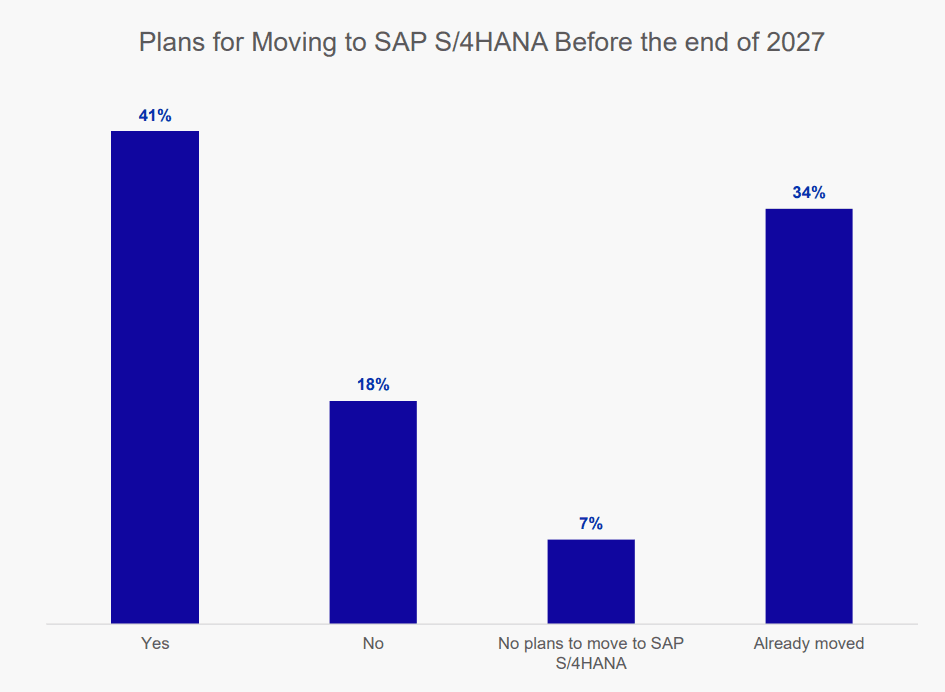
Source: SAPinsider SAP S/4HANA Migration Benchmark Report 2025
The Real Barrier: Data and Customization Complexity
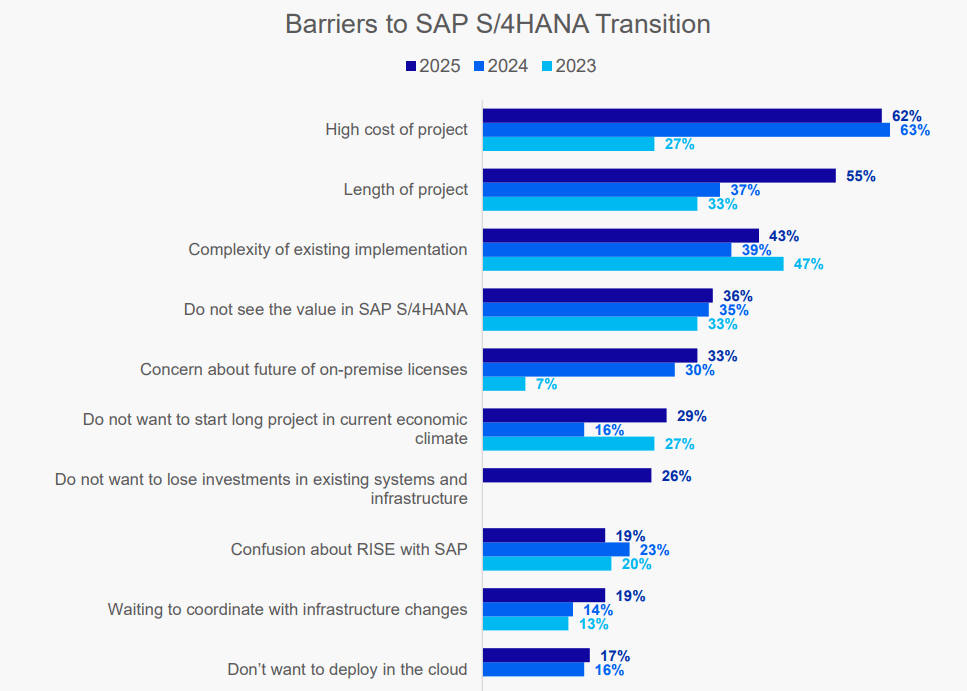
Source: SAPinsider SAP S/4HANA Migration Benchmark Report 2025
Independent industry analysis consistently shows that the primary challenge in SAP S/4HANA migration is not technical conversion – it is data and process complexity.
Legacy SAP systems often contain:
- Extensive customization
- Redundant historical data
- Inconsistent master data
- Poorly documented enhancements
- Mixed integration architectures
When these structures are migrated without structured scoping and validation, organizations experience:
- Increased cloud infrastructure costs
- Oversized HANA environments
- Longer project timelines
- Extended hypercare phases
- Higher long-term operational overhead
Cloud transformation without data reduction simply relocates inefficiency.
RISE with SAP Solves Infrastructure - Not Data Transparency
SAP introduced RISE with SAP as a bundled cloud transformation framework combining S/4HANA Cloud, infrastructure services, and subscription-based commercial models.
RISE addresses:
- Infrastructure migration
- Hosting and hyperscaler integration
- Commercial contract consolidation
- Standardized deployment models
However, RISE does not inherently determine:
- Which data should be migrated
- Which customizations are business-critical
- How legacy complexity should be reduced
- How delta validation should be performed
The responsibility for scope definition and data governance remains with the organization.
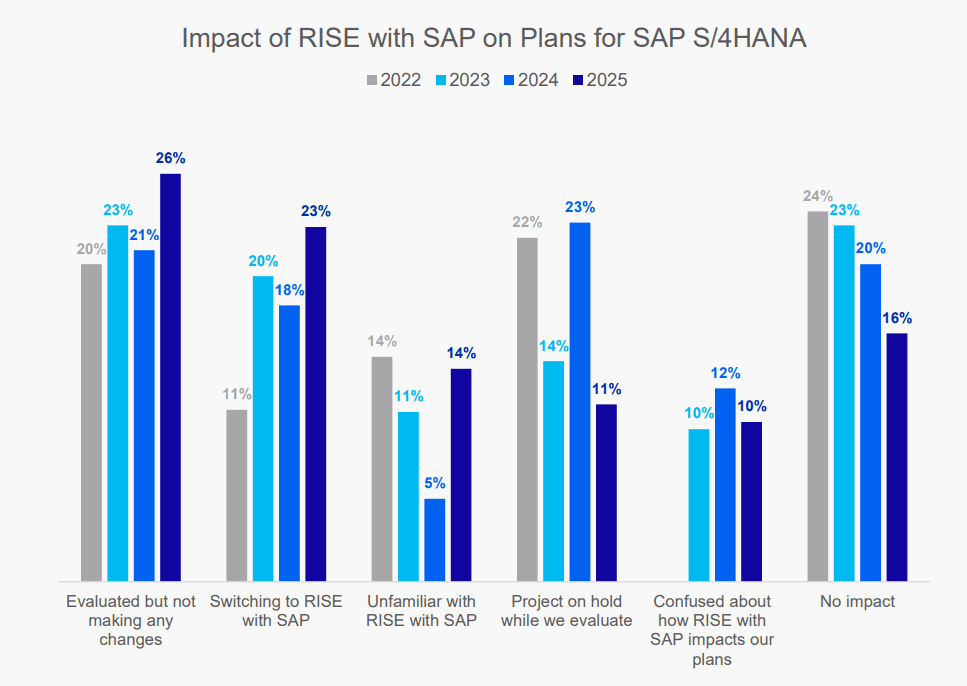
Source: SAPinsider SAP S/4HANA Migration Benchmark Report 2025
Where iVIEW for SAP Enters the Migration Lifecycle
iVIEW for SAP addresses precisely the areas that neutral research identifies as the most persistent migration risks.
Structured System Transparency
iVIEW for SAP provides deep visibility into existing SAP landscapes. It identifies active data usage, catalogs Z-transactions, and highlights obsolete or redundant datasets. This directly addresses the complexity challenges cited in industry research.
Data-Driven Scoping and Delta Analysis
Instead of migrating everything, iVIEW for SAP enables selective migration based on actual usage and business relevance. Delta comparisons between legacy and target systems reduce migration volume and cloud resource consumption.
Pre-Go-Live Data Validation
By embedding governance before cutover, organizations minimize data-related incidents during hypercare. This reduces stabilization time and improves reconciliation accuracy.
Hypercare Acceleration
Clear documentation and structured audit trails reduce Mean Time to Root Cause (MTTRC) and lower incident rates in the first 30 days post go-live.
Independent Research Confirms the Value of Governance
Academic and industry research consistently demonstrates that structured data governance reduces post-migration inconsistency and operational risk.
Organizations that implement formal governance frameworks experience significantly fewer production incidents compared to those relying solely on technical migration tooling.
The Strategic Equation for Successful SAP S/4HANA Migration
Successful migration requires three layers:
- Infrastructure and cloud framework (e.g., RISE with SAP)
- Technical execution tools (Migration Cockpit, ETL solutions)
- Data intelligence and governance (iVIEW for SAP)
Only when all three layers are aligned can organizations achieve:
- Controlled cloud costs
- Reduced hypercare duration
- Faster business stabilization
- Improved data quality
- Sustainable transformation outcomes
Conclusion: Migration Success Depends on Data Intelligence
Independent sources confirm that SAP S/4HANA migration is progressing – but remains complex and risk-prone due to legacy data and customization challenges.
Technical frameworks move systems. Data intelligence moves organizations forward.
iVIEW for SAP complements RISE and technical migration tooling by ensuring that only trusted, validated, and business-relevant data enters the new S/4HANA environment.
The difference is measurable – in cost, stability, and long-term transformation value.

