
From RISE with SAP to Data-Driven Execution
Why Transparency Determines Migration Success

SAP S/4HANA Migration in 2026:
A Strategic Imperative
SAP S/4HANA migration is more than a technical system conversion. Whether executed as Greenfield, Brownfield, Hybrid, or within the RISE with SAP framework, long-term success depends on one decisive factor: data transparency. Organizations that control migration scope, eliminate legacy complexity, and validate data before and after go-live reduce risk, shorten hypercare, and accelerate cloud ROI.
With the shift toward cloud-based ERP models and the evolution of enterprise IT landscapes, SAP S/4HANA migration has become one of the most significant transformation initiatives for global organizations.
The move from legacy SAP ECC or R/3 systems to SAP S/4HANA is not simply a database upgrade. It represents:
- Process simplification
- System standardization
- Reduction of technical debt
- Cloud transition
- Preparation for AI-enabled enterprise architectures
Yet despite modern tools and structured methodologies, many SAP S/4HANA migration programs face cost overruns, prolonged hypercare phases, and avoidable operational disruption.
The root cause is rarely technology. It is almost always data.

Migration Strategies: Greenfield, Brownfield, Hybrid
Organizations typically choose between three core approaches:
Greenfield
involves building a new S/4HANA system from scratch, adopting standardized best practices and selectively migrating data. It reduces legacy complexity but requires strong business involvement.
Brownfield
converts the existing SAP system technically to S/4HANA, preserving most processes and data. It is faster but carries legacy structures forward.
Hybrid
the selective data transition combines both models, selectively redesigning processes while migrating only relevant data.
Regardless of strategy, one question remains constant:
What data should be migrated and what should not?
RISE with SAP: The Cloud Transformation Framework
SAP introduced RISE with SAP as a bundled transformation offering designed to move customers to S/4HANA Cloud under a unified contract model.
RISE typically includes:
- SAP S/4HANA Cloud (Public or Private)
- Hyperscaler infrastructure
- Business Process Intelligence (e.g., Signavio)
- Technical migration services
- Consolidated subscription model
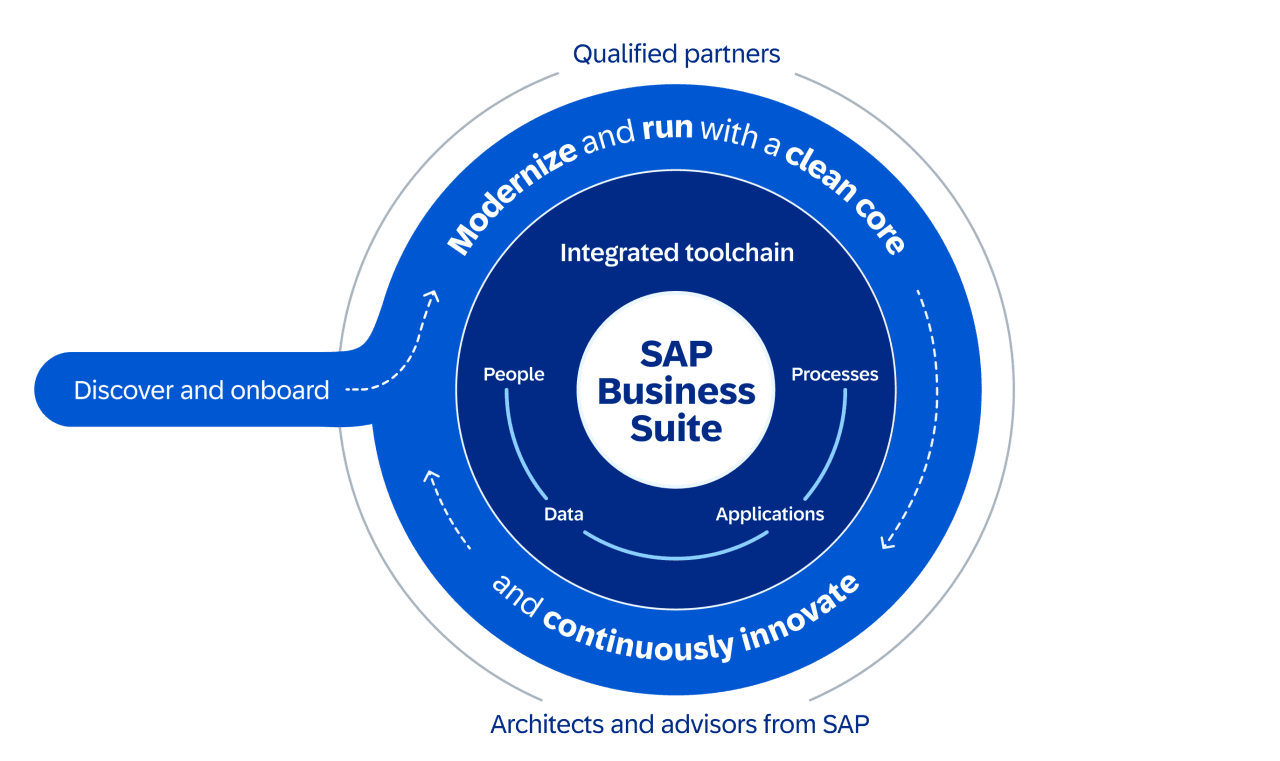
RISE simplifies the commercial and infrastructure side of transformation. It answers the question:
How do we move to S/4HANA Cloud?
However, RISE does not automatically solve:
- Data relevance decisions
- Migration scope definition
- Legacy data elimination
- Z-transaction rationalization
- Data validation before and after go-live
In cloud environments especially, unnecessary data directly increases infrastructure cost and system complexity.
Cloud migration without data minimization simply relocates inefficiency.
Why Scoping Is the Most Powerful Lever in SAP S/4HANA Migration
In practice, the scoping phase determines the financial and operational success of a migration.
Most SAP systems are historically grown, heavily customized, and insufficiently documented. Custom Z-transactions, unused master data, and redundant historical records increase database size and operational overhead.
Without structured transparency, migration teams often choose the “safe” path: migrate everything.
This approach leads to:
- Higher cloud subscription costs
- Larger HANA databases
- Longer migration runtimes
- Increased maintenance effort
- Extended hypercare stabilization
A structured current-state assessment combined with delta analysis between source and target systems significantly reduces these risks.
Selective migration is not riskier. Blind migration is.
Hypercare: Where Migration Quality Becomes Visible
After go-live, the hypercare phase begins. This stabilization period reveals whether the SAP S/4HANA migration was executed with sufficient transparency and validation.
Common post-go-live challenges include:
- Financial reconciliation mismatches
- Failed transactions
- Missing Master Data
- Inconsistent reporting
The central diagnostic question becomes:
Is the issue data-related or application-related?
Without documented delta comparisons and clear audit trails, root cause analysis can take days or weeks.
KPIs That Define Hypercare Excellence
Professional SAP S/4HANA migration programs measure hypercare performance using objective indicators:

Mean Time to Root Cause (MTTRC)
The average time required to identify the underlying cause of an incident. Structured data transparency can reduce this by up to 30–50%.
Incident Rate (First 30 Days)
Number of productive incidents post go-live. High rates often indicate insufficient data validation.
Data-Related Incident Ratio
Percentage of incidents caused by data inconsistencies rather than configuration errors.
Reconciliation Accuracy Rate
Alignment percentage between legacy and S/4HANA financial balances (>99.5% target for critical accounts).
Hypercare Duration
Time from go-live to transition into steady-state operations.
These KPIs are directly influenced by pre-migration data governance and scoping quality.
RISE with SAP vs. RISE + iVIEW for SAP
Dimension | Rise with SAP | RISE + iVIEW for SAP |
|---|---|---|
Primary Focus | Infrastructure & Cloud Model | Infrastructure + Data Governance |
Migration Scope | Technically defined | Data-optimized and controlled |
Legacy Elimination | Manual | Automated identification & rationalization |
Z-Transaction Transparency | Limited | Full cataloging & usage analysis |
Data Validation | Standard Tools | Structured delta comparison |
Cloud Cost Optimization | Indirect | Direct through data minimization |
Hypercare Stabilization | Reactive | Proactive root cause clarity |
Audit Trail | Partial | Full migration documentation |
RISE moves you to the cloud. iVIEW for SAP ensures you move the right data.
iVIEW for SAP: The Data Intelligence Layer
iVIEW for SAP complements the RISE framework by introducing structured data transparency before migration begins. It enables organizations to clearly identify which data is actively used, detect redundant or obsolete datasets, and systematically catalog custom Z-transactions. Through structured delta analysis, source and target systems can be compared in detail, ensuring consistency and completeness throughout the transition. In addition, iVIEW for SAP supports the generation of audit-ready migration reports and significantly accelerates root cause analysis during hypercare. Instead of transferring legacy complexity into the cloud, organizations migrate only trusted, relevant, and business-critical data, creating a leaner, more controlled S/4HANA environment.
Successful SAP S/4HANA migration
Executive Perspective for CIOs
Cloud migration is not transformation by default.
Infrastructure consolidation, subscription models, and standardized deployment reduce technical complexity — but they do not automatically eliminate historical inefficiencies embedded in data structures.
CIOs who combine RISE with structured data governance gain measurable advantages:
- Lower long-term cloud expenditure
- Reduced migration risk
- Shorter hypercare stabilization
- Higher trust in financial reconciliation
- Faster realization of transformation ROI
The strategic differentiator in SAP S/4HANA migration is not infrastructure — it is data clarity.
A Strategic Transformation
SAP S/4HANA migration is a strategic transformation journey. RISE with SAP provides the cloud framework. But sustainable value creation requires more than technical relocation.
Organizations that integrate structured scoping, delta validation, and data governance into their migration approach achieve:
- Simplified system landscapes
- Controlled cloud costs
- Reduced operational risk
- Accelerated stabilization
- AI-ready enterprise data foundations
SAP S/4HANA migration succeeds when trusted data leads the transformation.

